top of page

Designed for Real Schools, Not Just Demos
ECHO is built for fast installation, legal compliance, and long-term operation in environments where traditional surveillance cannot be used.
Target Deployment Environments
ECHO is deployed only in locations where cameras and audio recording are prohibited, closing critical safety gaps without introducing surveillance.

School Bathrooms

Counseling / wellness spaces

Locker Rooms

Other camera-restricted areas
What a Deployment Includes

-
Compact, wall-mounted ECHO device
-
On-device AI processing (no cloud required)
-
Local alert integration with existing school safety workflows
-
No audio storage, no data retention infrastructure
From Installation to Operation
01
Site Selection
Identify camera-restricted, high-risk areas with school administrators.
02
Device Installation
ECHO devices are installed discreetly and configured for the acoustic environment.
03
Alert Integration
Alerts are routed to existing staff or safety response channels.
04
Ongoing Operation
Devices run continuously with stable, on-device inference.
Model Accuracy & Reliability
“Validated on non-semantic acoustic events—without retaining speech or storing audio.”
Evaluation Methodology
ECHO’s models were evaluated on short, non-semantic acoustic events (e.g., impact, sustained distress, emergency-like sounds) collected in simulated school hallway environments.
All evaluation was performed on-device, using transient acoustic features only. No speech transcription, raw audio storage, or personal identifiers were used at any stage of testing.
Improved Detection with Lower False Alerts
System | Macro F1 | False Alerts / Hour | Median Latency |
|---|---|---|---|
ECHO (Full Pipeline) | ~0.77 | ~0.21 | ~424ms |
Tuned Baseline | ~0.60 | ~0.52 | ~539ms |
Baseline | ~0.43 | ~0.82 | ~698ms |
Multi-stage validation significantly reduced false positives while improving overall detection accuracy.

Consistent Performance Across Safety-Relevant Event Types
Performance gains were observed across all evaluated event classes, including high-variance environments and varying ambient noise levels.
Class-level F1 scores improved consistently after multi-stage temporal validation, indicating robustness beyond single-event spikes.
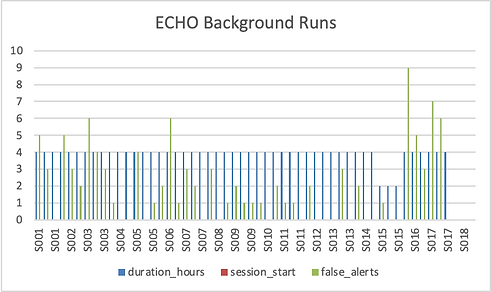
Stable Operation in Continuous Background Monitoring
ECHO was evaluated in continuous background operation to measure alert stability over time.
Multi-stage validation prevents spurious triggers from isolated noise events, resulting in predictable alert rates suitable for real school deployments.

Precision–Recall Tradeoff Across Detection Thresholds
This curve illustrates how ECHO balances detection sensitivity and reliability as the alert threshold is adjusted.
Lower thresholds increase recall but introduce more false positives, while higher thresholds reduce false alerts at the cost of missed detections. ECHO is intentionally tuned to operate in a conservative region that prioritizes low false alarms while maintaining meaningful detection coverage—reflecting the realities of continuous deployment in schools.
bottom of page